Steel Pier, Atlantic City
Steel Pier, Atlantic City
Showplace of the Nation
Steve Liebowitz
Couldn't load pickup availability
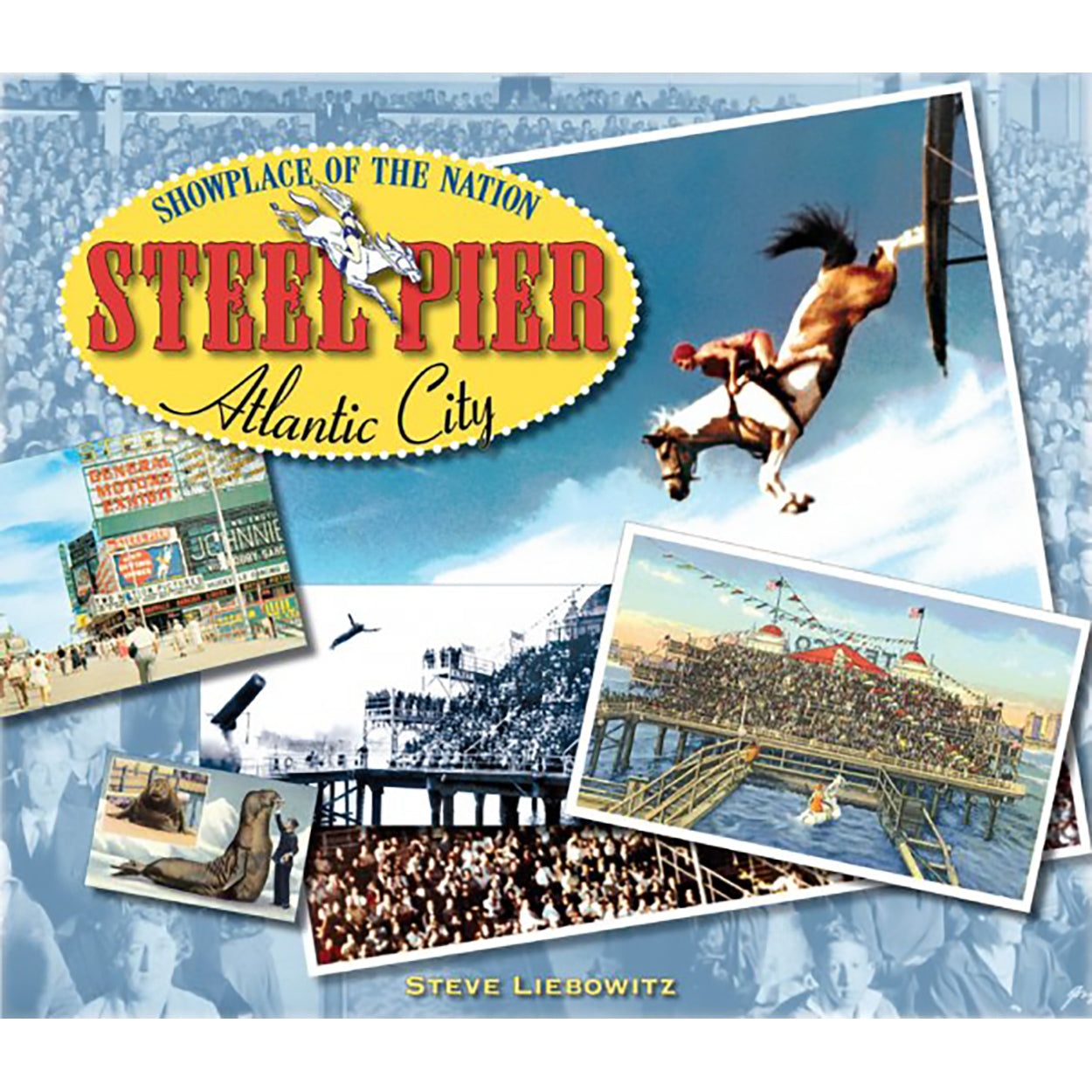
It was aptly called the “Showplace of the Nation” and it was all that and more.
There were big bands, movies, sideshows, acrobats, flag-pole sitters, Miss America — and throngs of people lining up to sit on bleachers to watch World Famous High Diving Horses and their brave riders dive into a pool of water.
For much of the 20th century Steel Pier in Atlantic City was the center of American entertainment on the East Coast. Nearly every big-name entertainer — from John Philip Sousa and his band to Tommy Dorsey, Benny Goodman and Frank Sinatra – played there. And nearly every form of entertainment that could be imagined took place at Steel Pier — from high wire acts to people being shot out of cannons, from Hawaiian High Divers to the Diving Bell that took you to the sea floor.
There was the Marine Ballroom, and there was rock and roll. There were circus-like animal acts – “Rex The Wonder Dog,” a 70-ton Whale, Fortune-Telling Parakeets, Wild Animal Babies, and Boxing Cats. This all-in-one entertainment Mecca, novel in its day, has never been matched, not even at latter-day theme parks. Where else could you take the entire family for a day and see the World of Tomorrow, Sousa and his band, a bear on a bicycle, and the High Diving Horses? Or take a ride below the sea, spend the evening in the marine ballroom, and see a movie — all for one ticket? It was a colossal offering of escape, popular culture, fun and fantasy.
They came in droves from the cities – Philadelphia, Camden, Pittsburgh, New York, Newark, Wilmington, Baltimore – throughout the northeast and beyond, by train and by car – entire families – drawn to this fantastic pier over the Atlantic Ocean. They were guided by billboards, kitschy roadside displays, and signs painted on inner city buildings. The marketing was hyperbolic – even by today's standards. But, with Steel Pier, the hype actually matched what was being offered.
Today, the novelty and innocence of the golden age of the Pier seems a world apart. Yet it was an institution — not to be missed. It was an empire of grand-thinking impresarios, oddities and glamour that meshed into one cohesive and attainable summer destination.
Steel Pier, Atlantic City: Showplace of the Nation, examines this attraction in a large-format, full-color coffee-table book. Author Steve Liebowitz begins with a brief history of seaside entertainment piers, competing piers in Atlantic City (such as Million Dollar, Heinz, and Steeplechase), and the uniquely American opportunities that Atlantic City presented its owners. The book carries us through incarnations of Steel Pier into the late 20th Century.
Filled with 227 historic photographs and other images, this book chronicles the rise of one of America’s most remarkable entertainment venues — “A Vacation In Itself,” as the slogan went — and how it mirrored American society from 1898-1978. For three-quarters of the last century, long before theme parks were imagined, there was nothing like it. Steel Pier was Atlantic City.
In fact, Steel Pier was an incredible combination of Broadway, Miami, Las Vegas, Hollywood, Barnum and Bailey, and a state fair — “All For One Low Admission.” Crowds were drawn from New Jersey, New York, and Philadelphia, of course, but also from the entire country. The renown of Steel Pier was so great that A-list performers chose the Pier over other venues.
A fascinating contribution to not only New Jersey and Atlantic City history, but also the history of American entertainment and popular culture, Steel Pier, Atlantic City evokes a time when there was so much invention, talent and industry that it could only be experienced in one place — at the edge of the continent, in a city that took its name from a vast ocean, on a great pier reaching out into the sea.
Pages: 263
Share
Dimensions: 9.75” x 11.25” x 1"
What is a hurt book?
What is a hurt book?
When we receive books returned from stores and distributors that have been slightly scuffed, or with dings or sun-faded covers, we offer them at a big discount. We call them "hurt," but other than minor cosmetic damage, these are perfectly good books — almost always clean and unmarked inside. In many cases they are in like-new condition. Available 1st-come-1st-served; best condition books are shipped first.
Another Review
Another Review
“An exhaustively researched and impressively illustrated history of what, for a large chunk of the 20th century, was celebrated far and wide as ‘the showplace of America.’”
— Philadelphia Daily News
More Reviews
More Reviews
“…As I turned the pages of this book and saw so many, many people having the time of their lives, I began to care, not so much about a place that has come and gone, but about the kind of imaginative, entrepreneurial spirit that made Atlantic City the fun, fascinating place it was. ...Read this book, and make history repeat itself.”
— The Philadelphia Inquirer
“Chronicling the Pier’s history — and more… in 263 picture-packed pages.”
— The Press of Atlantic City
“Celebrates Atlantic City’s magical Steel Pier.”
— Courier Post
“An homage to Atlantic City’s best-known entertainment mecca.”
— Baltimore Jewish Times
“Almost as much fun as a day on Steel Pier, and as close as you can get to it in the 21st Century.”
— The SandPaper
“Covers the great entrepreneurs and showmen who made the pier run — through the vaudeville acts and stars of the ‘20s and ‘30s, the diving horse era, the big band era and the rock’n roll of the ‘50s and ‘60s.”
— Atlantic City Weekly
Blurb
Blurb
“Steel Pier, the ‘Capital of Americana,’ was an entertainment destination never to be replicated.
It deserves a book of its own!”
— Vicki Gold Levi, author of Atlantic City: One Hundred Twenty-Five Years of Ocean Madness
and a historical picture editor, photography curator, and co-founder of the Atlantic City Historical Museum.
More Info...
More Info...
From the Inside Flap
There was nothing else like it. For much of the 20th century it was the center of American entertainment on the East Coast. There were big bands, movies, sideshows, acrobats, flag-pole sitters, Frank Sinatra, Miss America and throngs of people lining up to get a seat so they could watch brave horses and riders dive into a pool of water. It was aptly called the Showplace of the Nation and it was all that and more. It was Steel Pier.
This all-in-one entertainment mecca, novel in its day, has never been matched, not even at latter-day theme parks. Memories of the excitement and wonder of Steel Pier remain untarnished.
Where else could you take the entire family for a day and see fortune-telling parakeets, the World of Tomorrow, John Philip Sousa and his band, a bear on a bicycle, World Famous Diving Horses, take a ride below the sea in the Diving Bell, spend the evening in the marine ballroom, and take in a movie all for one ticket? It was a colossal offering of escape, popular culture, fun and fantasy.
There will be nothing like it again. Today, the novelty and innocence of the golden age of the Pier seems a world apart. Yet it was an institution a grand treat served up with gusto and cotton candy, a destination not to be missed and an empire of talent, grand-thinking impresarios, oddities and glamour that meshed into one cohesive and attainable summer destination.
Even today, though Steel Pier still exists, people who had experienced the glory days whether during the big band era, rock and roll in the 60s, or the early days of the automobile still feel the need to share their memories of this unique, beloved venue. This structure of wood and steel became much more than the sum of its parts: Even fires and storms couldn’t dim the memory of the grand, the great, the always-surprising Steel Pier — “The World’s Playground.”
STEEL PIER TIMELINE
1898 - Steel Pier opens on June 18 with Minstrels, Grand Cakewalks, Children’s Novelty Balls, Promenade Concerts & Dances and Grand Sacred Concerts.
1908 - Motion pictures are first shown.
1920 - An Aero Exhibit in the Arcade and Ballroom present the Wireless Phone.
1922 - World-famous tenor Cantor Josef Rosenblatt performs in the Pier’s Convention Hall for the benefit of the Hebrew National Orphan Home of New York.
1925 - Businessman Frank Gravatt buys the Pier and begins its transformation into an entertainment complex. He expands the existing buildings and builds space for attractions such as the General Motors Exhibit.
1926 - Ted Weems’ Orchestra is the first name band to play in the Marine Ballroom, WPG radio becomes the only station on an ocean pier. Gertrude Ederle, the first woman to swim the English Channel, becomes the first “big” name to draw a crowd. Famed Irish tenor John McCormack performs, tickets are $2.50 per seat.
1927 - Marion Talley, a star with the Metropolitan Opera, performs in May. John Philip Sousa, America’s “March King,” makes his Pier debut under Gravatt with two afternoon and two evening concerts.
1928 - “Nowhere else can you see so much for so little money,” say the ads. Hawaiian hula singers and dancers, surfboard riders, divers and swimmers perform as a nucleus for the Water Circus. Captain Wilkins, the famous aviator who flew over the North Pole, lectures alongside his plane.
1929 - The Diving Horse makes its Steel Pier debut — along with another first, the human cannonball — advertised on a new sign boasting the Pier as “The Showplace of the Nation.” Both feature female performers. Independence Day weekend features “Dutchy” Wilde, “the world’s greatest daredevil,” leaping into the ocean from a low-flying airplane – without a parachute. Lt. Cmdr. John Philip Sousa returns to the Music Hall to lead four concerts by his famous march band. “Television – the latest wonder invention of the electrical world,” is introduced.
1930 - “The World’s Mightiest Show –16 hours of continuous amusement starting at 10 AM every day – 20 world famous attractions for one admission.” George Jessel becomes the first vaudeville star to headline the Pier in the Music Hall, with Eddie Cantor following. A dead 70-ton whale is exhibited. The ocean end of Steel Pier features yacht races. The Pier remains open year round.
1931 - Exciting attractions are added including boxing cats, parachute jumping, an Autogiro plane and a rocket-powered glider. Ce-Dora defies death on a speeding motorcycle in a 16-foot globe, while six daredevil aerial acrobats perform 100 feet in the air. John Philip Sousa appears for the last time.
1932 - The steamship S.S. Steel Pier offers daily excursions from the end of the Pier. Pete, the “Our Gang” dog, begins an annual summer stay on the Pier, posing for pictures. Rudy Vallee makes his first of many appearances, bringing in record crowds along with Boris Karloff’s “Frankenstein” motion picture.
1933 - The Pier proclaims “It’s a Big Vacation in Itself.” The world’s largest captive sea elephant is exhibited. Top radio stars Amos ’N Andy appear on Easter and perform countless times between two theaters to accommodate enormous crowds. George Burns and Gracie Allen appear, as does new heavyweight champion Primo Carnera, who boxes with a kangaroo. A young Milton Berle also appears.
1934 - Broadcaster Lowell Thomas goes national from the Music Hall. “Belle of the Nineties,” a Mae West picture, makes its world premiere. On Labor Day, the Pier proclaims, “66 hours of consecutive entertainment – this morning at 8 AM we will be open.... until Tuesday, September 4 at 2 AM. ” Attractions include the radio cast of “The Goldbergs,” the opera “Carmen” sung in English, and Ozzie Nelson’s Orchestra with Harriett Hilliard.
1935 - Daddy Dave’s Kiddie Revue begins its regular run. “The Little House” exhibits the most modern appliances. Bob Hope, with wife Dolores Reade, appears in May, Guy Lombardo brings his orchestra in August. Miss America is crowned on Steel Pier, which hosts the pageant four more years. Major Bowes’ Amateur Hour is broadcast nationally from the Casino lobby in December.
1936 - Ford opens an exhibit in the front of the Pier. The comedy team of Bud Abbott and Lou Costello joins the minstrel troupe. Rex joins the Water Circus as the world’s only aquaplane-riding dog. Benny Goodman and Tommy Dorsey bring their famous big bands. The Three Stooges also first appear.
1937 - Rising comics Red Skelton and Henny Youngman make their Pier debuts. Child prodigy Bobby Short appears in a vaudeville Christmas program.
1938 - The Kennel Club of Atlantic City holds its 19th Annual Dog Show, with 600 dogs and 80 breeds present. Drummer Gene Krupa debuts his orchestra in the Marine Ballroom to a packed crowd of screaming fans. Benny Goodman broadcasts his “Camel Caravan” show nationwide from the Ballroom in August.
1939 - The Harry James Band plays for the Easter crowd, and an unknown singer named Frank Sinatra makes his Steel Pier debut with the band. The Four Ink Spots become the first African-American headliners, and the Andrews Sisters first appear.
1940 - Legendary bandleader Glenn Miller appears in August.
1941 - Elsie, the famous Borden cow, is exhibited in her own boudoir. Future “Honeymooners” star Art Carney is an unknown in a July vaudeville program. Abbott and Costello, now stars, return as their film “Hold That Ghost” plays in the movie theater. Rising singer Dinah Shore appears, as does the Artie Shaw Band.
1942 - First season for a trip to the ocean bottom in the Diving Bell. Admission for servicemen is 30 cents at all times, plus they can also send a record back home to their loved ones for free. Wild man Louis Prima and his band perform.
1943 - The minstrels hang it up due to indifference and the loss of many entertainers to wartime. Jimmy Durante is one of the few big names to appear this summer.
1944 - New heartthrob singer Perry Como is featured in August. September hurricane causes havoc in Atlantic City and destroys the Water Circus.
1945 - George Hamid buys the Pier from Gravatt, continuing “all for one admission.” The Exhibit of Bombs - “See close up the kind of bombs our planes are dropping on the Japs.” Rising comedian Jackie Gleason hits the Music Hall stage.
1946 - The Harry James Band draws 27,000 people on Easter. “The Outlaw,” a risqué Western produced by Howard Hughes, receives major publicity and an appearance by star Jane Russell. Rosemary Clooney makes her debut with Tony Pastor’s Band.
1947 - The General Motors Exhibit returns to the front of the Pier.
1948 - Television is featured on a giant screen in the Ocean theater. Peggy Lee sings in the Music Hall with husband Dave Barbour and his trio.
1949 - Tony Grant takes over the Kiddie Revue and stays until the Pier’s final days.
1950 - All-around entertainer Danny Kaye arrives in July. Frank Sinatra’s non-stop Labor Day performances for record crowds cause him to temporarily lose his voice.
1951 - Billy Eckstine becomes the first solo African-American singer to headline on the Pier. He is supported by new comedian Alan King.
1952 - The Steel Pier radio show broadcasts live from the Lobby almost daily from 11:35 p.m. to 5 a.m. with guest stars and promotions. Guitarist Les Paul appears with wife Mary Ford. Gary Cooper’s “High Noon” keeps moviegoers captivated.
1953 - The famed Diving Horses return. Young comic Joey Bishop is part of the bill with singer Fran Warren. New singers Tony Bennett and Eddie Fisher appear. Louis Armstrong is the first African-American musician to headline, but plays the Music Hall, not the Ballroom. The Casino is remodeled and renamed the Ocean Theater.
1954 - Former bandleader Paul Whiteman begins a weekly ABC television series, “On the Boardwalk,” broadcasting every Sunday from the Midway theater. Popular music is changed forever as Bill Haley and the Comets rock the Music Hall.
1956 - Teen idol Pat Boone stars in July, jazz-stylist Sarah Vaughan in August.
1957 - An eclectic bill in July presents singers The Diamonds, pop singer Steve Lawrence, and the orchestra of Woody Herman.
1958 - Philadelphia radio disc jockeys Joe Grady and Ed Hurst begin record hops, some televised from the Pier. Danny and the Juniors, Connie Francis and Paul Anka are booked. The Pier’s wildest day ever is September 1, when over 44,000 pay to witness Ricky Nelson’s first public appearance.
1959 - Teen idols Fabian, Bobby Darin and Frankie Avalon appear.
1960 - Bobby Vinton and Johnny Cash arrive, as does Dick Clark’s “Cavalcade of Stars,” featuring Bobby Rydell, the Crew Cuts and more.
1961 - Chubby Checker becomes the first black rock ‘n’ roll headliner.
1962 - A monster storm in March pushes a barge through the Pier, destroying the Home of the Century and leaving the Marine Ballroom cut off.
1964 - Duke Ellington is the first African-American band leader to play the Marine Ballroom. The Beatles’ movie “A Hard Day’s Night” plays the Pier.
1965 - The Supremes, Gary Lewis and the Playboys, Herman’s Hermits, Peter and Gordon, and Sam the Sham and the Pharaohs all headline. Future Vegas star Wayne Newton also makes an appearance.
1966 - The Rolling Stones appear July 1 for two shows, along with the McCoys and the Standells. Stan Kenton and his band play in the Ballroom that day. Others this summer are Stevie Wonder, Frank Sinatra Jr. and the Count Basie Band.
1967 - Ray Charles performs during the Independence Day holiday.
1968 - The Giant Skywheel, a ride directly from the New York World’s Fair, opens on the Pier. Top acts include the Beach Boys and the Box Tops.
1969 - Tiny Tim proclaims his love for Miss Vicki on the Music Hall stage. The Marine Ballroom, Water Circus and a portion of the Pier is destroyed by fire.
1970 - A geodesic Gold Dome replaces the Ballroom on the Pier’s outer end. The Ocean World Theatre of the Sea opens in the vacated General Motors space.
1971 - George Hamid dies May 28 at age 75. The Allman Brothers and the Cowsills are featured in July. Cab Calloway and Chuck Berry appear.
1973 - George Hamid Jr. sells the Pier to a group of businessmen on January 16, but will lease it for two more years. The “Brady Bunch” Kids appear on May 25.
1974 - More TV stars appear, including Danny Bonaduce of “The Partridge Family” and Barry Williams of “The Brady Bunch.”
1976 - The new owners remodel the entire Pier, discard all of the classic signs and tear down the Music Hall and Midway theaters. The Bay City Rollers perform to a frenzied crowd. Woody Herman leads the last big band to play Steel Pier.
1978 - The Pier closes for the last time in September, effectively signaling an end to the Diving Horse act and Tony Grant’s “Stars of Tomorrow.”
1979 - Frank Gravatt dies on January 28 at age 89. The Casino building is used sporadically for boxing and wrestling events.
1982 - Primarily used for storage, most of Steel Pier burns to the ground in a December arson.
1988 - The dilapidated Gold Dome, Water Circus area and Diving Bell are finally torn down as a New Steel Pier arises.
2011 - On August 3, after leasing the Pier for 20 years, the Catanoso family and partners bought Steel Pier from Trump Entertainment for $4.25 million.
Excerpt
Excerpt
Steel Pier evokes a time when more really was more, a time when there was so much invention, talent and industry in the country that it could only be experienced in one place at the edge of the continent, in a city that took its name from a vast ocean, on a great pier reaching out into the sea.
***
For much of the 20th century Steel Pier in Atlantic City, NJ, was the center of American entertainment on the East Coast. There were big bands, movies, sideshows, acrobats, flag-pole sitters, Frank Sinatra, Miss America — and throngs of people lining up to get a seat so they could watch brave horses and riders dive into a pool of water.
It was aptly called the ''Showplace of the Nation'' and it was all that and more. This all-in-one entertainment mecca on the Boardwalk, novel in its day, has never been matched, not even at latter-day theme parks. Where else could you take the entire family for a day and see fortune-telling parakeets, the World of Tomorrow, John Philip Sousa and his band, a bear on a bicycle, World Famous Diving Horses, take a ride below the sea in the Diving Bell, spend the evening in the marine ballroom, and take in a movie — all for one ticket?
It was a colossal offering of escape, popular culture, fun and fantasy. It was a grand treat served up with gusto and cotton candy, a destination not to be missed — an empire of grand-thinking impresarios, oddities and glamor that meshed into one cohesive and attainable summer destination.
This large-format coffee-table book includes 227 historic photographs, illustrations, and advertising images.
Steel Pier evokes a time when more really was more, a time when there was so much invention, talent and industry that it could only be experienced in one place — at the edge of the continent, in a city that took its name from a vast ocean, on a great pier reaching out into the sea.
Another Excerpt
Another Excerpt
REMEMBERING STEEL PIER
“I have memories of going on the Steel Pier in 1928, when I was 11, packing a lunch and staying there all day so we could see the water sports and as many shows as time would permit.” — Phoebe Maley (The Press of Atlantic City, June 1991)
“Steel Pier was a place I never tired of. Each week the acts and the movie would change. There was a fun house outside one of the movie theatres, and a house of mirrors, also some antique furniture. Trained parakeets would perform really unique tricks, such as picking up a piece of paper and bringing it to a special box. A magician would perform marvelous card tricks and sold special decks of cards. There were clowns who would dress up in early 1900s bathing attire and perform all types of antics using the Pier and the ocean. And there were high-wire acts involving walking and riding a bicycle across the ocean from the stage to the spectator sections.” — Jim Mannion
“Work on the Pier hardly seemed like work at all. We were young, strong and athletic. We were the ones working behind the scenes to make the Pier a famous attraction. All the plumbers, electricians, carpenters and painters were in-house. Every year, we repainted benches and replaced broken stairs, worn dance floors, and rails along the ocean. When the Pier closed after breaking the attendance record for Labor Day Weekend 1934, we had 2 hours to clean four theatres before we opened for business again. Our work on the Pier was a round-the-clock effort.
From 1935 to 1937, my friend Walter Rossi and I took jobs as guards for the dressing rooms of the Miss America Pageant, held at the Marine Ballroom. The work was exhilarating. We wore white shirts, white flannel trousers, and white bucks. We stood guard in front of the doors to make sure no one tampered with the costumes or bothered the contestants.
In 1937, I got a lucky break and became the manager of the Music Hall. My last job on the Pier was as Assistant Manager of the Front, operated by James Rock. James taught me a lot about show business.
The Pier averaged 35,000 visitors a day and was the place to see and be seen. Gentlemen wore their best suits, and ladies wore their best dresses, hats and furs. On the Sunday before Labor Day in 1934, the Pier set an attendance record: 89,000 visitors during the 20 hours the Pier was open. That same weekend, the Million Dollar Pier drew 62,000 people. Life magazine wrote an article about this event.
In 1939, I left the Steel Pier.” — Russ LeVan, Memories of AC, NJ – The Queen of Resorts (Gateway Press Inc., 1998)
“I could write volumes about Steel Pier. I knew every way to sneak in that was possible. In fact, my friend even developed a way or two...
We snuck into Steel Pier every day from roughly 1959-1963 when we weren’t working, until finally my cousin hooked us up with someone who “passed” us in legally. I saw every act a million times. We tortured the Fun House guards. They could never find us. We knew every secret passage, and if we had to, we made our own…
We never paid to get in. Of course, knowing the owner’s son helped. What a relief that was when we could just go in the employee entrance instead of shimming out over the pipes and climbing up the trap door under the stage. The Hamids were real gentlemen…
Riding the pipe to get into the Pier was a trip. Of course, we had rust on our clothes when we were finished. My friend was the guy who sawed the hole in the bottom of the Pier that led you under the Music Hall stage and let you out on the side of near Pennsylvania Avenue. He also spanned the area with wood between the pipes to make it easier to climb out there during high tide and stay dry…
The hole in the Pier existed before we ever attempted to reopen it. Originally, it was probably an access hole for plumbers to get to the pipes. Below the Pier were a maze of pipes, some 12 inches thick and some smaller. They all pretty much ran close together. This feature was conducive to laying boards across the pipes to form a platform of sorts. With a platform to be used as a working surface, one could lie on one’s back and perform all sorts of carpentry tricks, recreating the famous Steel Pier under-the-stage secret entrance…
Over the years there were at least three secret entrances that I knew about. The one we liked and by far the best was the one that let you out under the stage. When the shows were on, we could hear the music of the dancers and feel the pounding above us of the acrobats…
Since we snuck in almost all the time, over a number of years, I cannot remember acts except for Johnnie Ray and the Lennon Sisters. One act I recall was Wells and the 4 Fayes, an acrobatic act that wore funny costumes. We snuck in so many times when they were on stage that I actually got to meet Wells, a very nice chap. He knew we were sneaking in and I supposed just ignored it. Oddly enough, this same act was one of the opening acts for the Beatles when they were on Ed Sullivan’s Show…
The person who sawed the hole reopened was Dennis, the skinniest, shortest, bravest of the group. He shimmied out over the breaking waves ten feet above them to use a hand-held crosscut saw to reopen the hole. I remember it was high tide on a nasty day when he did it. We had to be careful, since people seeing us doing this might report us to the lifeguards at Virginia Avenue Beach Patrol station. Luckily, I knew the two lifeguards at that beach and they never bothered us. Anyway, the worse the weather, the easier for us...
I know many more people used this hole than we did. In fact, the reason it was closed in the first place was related to the other dopes who got caught and showed management where the hole was. Two of our guys were caught coming out of the backstage door by ushers, but refused to tell them anything...
When we knew that one of the ushers suspected someone had snuck in and set a trap for us, we would wait until we heard the crowds exiting. We would try to blend in with them by opening the door and walking with a crouch and backwards until we could emerge. It always worked...
Other ways to sneak in was from under the Boardwalk via the Fun House... quite scary and very dark... Guess we weren’t very claustrophobic then… The other was so obvious and stupid... the old squeeze through the bent gate when Lester Jackson would see us from his office and come out after us. We always outran him. Once, he was MC at the Tony Grant show and spotted us in the back. He had us removed by the security guards, but we were back the next day. I can remember getting to the reserved seats section in the Music Hall, which cost 25 cents extra, by crawling between the seats on the floor down to the front rows. Nice.” — Ratso, Philadelphia